


An Untold History
- Dec 22, 2017
- 10 min read
"You have to know the past to understand the present."
- Carl Sagan.
More often than not we come across people who say, History is boring, but the moment we talk about Egyptian tombs and Greek wars they get very interested. So it is safe to say when they say "History is boring" what they mean is "Indian History is boring".
Actually they are quite right, the history that we are being taught basically has three phases.
1. Early Phase(....- 200 BCE) Indus valley civilization and consequent Aryan invasion theory. How Ashoka felt remorse, planted trees on either sides of the roads and became a pacifist upon taking Buddhism.
2. Medieval Phase(998 AD- 1030 AD & 1191 AD-1700 AD) How the Iranians, Turks and the Mongols invaded India, set up their empire in Delhi and how the power transitioned through their dynasties and building of the Magnificent tombs, gardens and town-halls.
3. Modern Phase(1757 AD- 1947 AD) How the East India Company and the British consolidated the power and finally how the Congress liberated India.
In all these phases the core backdrop remains the same, The foreigners invade India, the Indian kings fail terribly in fending off the invaders and how the Indians lacked the sense of nationhood.
It looks so as if India was ruled by a bunch of barbaric tribes who fought among themselves and failed to keep up with the world especially in the aspects of technology and trade.
But the evidences beg to defer. The largest known religious monument, Angkor Wat is an Indian temple which is located in Cambodia, the best steel swords even by today's standards were smelted in India. This wouldn't have been possible without technology or trade.
So, why does the academic history ignore all the achievements and advancements but rather concentrates on who invaded Delhi who colonized India?
The answer to this million dollar question is simple. It is just to serve the political interests of the British and people who came to power after India's independence.
Now, this brings us to the questions:
-What is History ?
-In what way is Indian History doctored ?
-History is nothing but an interpretation of past events based on facts and evidences. One has the right to interpret but one doesn't have the right to facts. One can make any interpretation of any event as long as it remains loyal to the facts. History should not be altered and edited out to serve one's interests.
-Most of the Indian history is Delhi-centric because that was the region which was constantly invaded in which the native rulers i.e Indian rulers always lost. So, rather than glorifying the history in which Indians defeated the invaders our history books tend to edit out these events so as to make us feel that we were always ruled by weak rulers and the invasions were part of "Civilizing" India.
Below are a handful of alternate events which took place in the aforementioned three phases of Indian history which were conveniently swept under the carpet.
1. Early Phase(....- 200 BCE)
The Aryan Invasion Hoax:
The oldest known civilization, the Indus Valley Civilization is often regarded as a subject of controversy. Especially the "overnight" extinction of the civilization.
There are a couple of theories, but the most popular one was the "Aryan Invasion" theory. This theory was popular because it was based on the linguistic similarities between Sanskrit and the Central Asian languages.
According to this theory a large horde of tribes from now what's called Iran charged into the cities of Harappa and Mohenjodaro on horse backs and iron weapons and pushed them into central India to the Gangetic planes which eventually led to the Vedic Civilization.
This is false on many accounts. In 2006 a study by the "The American journal of human genetics" showed that the Indian population has been broadly stable for a very long time and there had been no major injunctions of genes for over 10000 years. So, if there had been any injunctions it should have been before 10000 years. Now this is where it gets interesting, before 10000 years the central Asian region was still experiencing the last Ice Age. It was so cold, the region was mostly uninhabited.
The British propagated this theory even though it didn't have any textual and archaeological evidence because it was politically convenient at that time as it painted them as merely latter day Aryans with a mission to civilize the natives.
It is sad that even after the independence most of the history books still teach this hoax.
Ashoka, a bad chap:
What we are taught of Ashoka is, Ashoka a bad chap who killed his elder brothers who were Jain Ajeevikas(a sect) to usurp the throne and waged a war against Kalinga which consumed thousands of lives after which he felt remorse and took up Buddhism and lead a life of a pacifist ever since.
Now according to Asokavadana, a Buddhist text about the life of Ashoka says that Ashoka was bad tempered and of wicked nature in fact he was called 'Chandashoka' which means Ashoka the cruel.
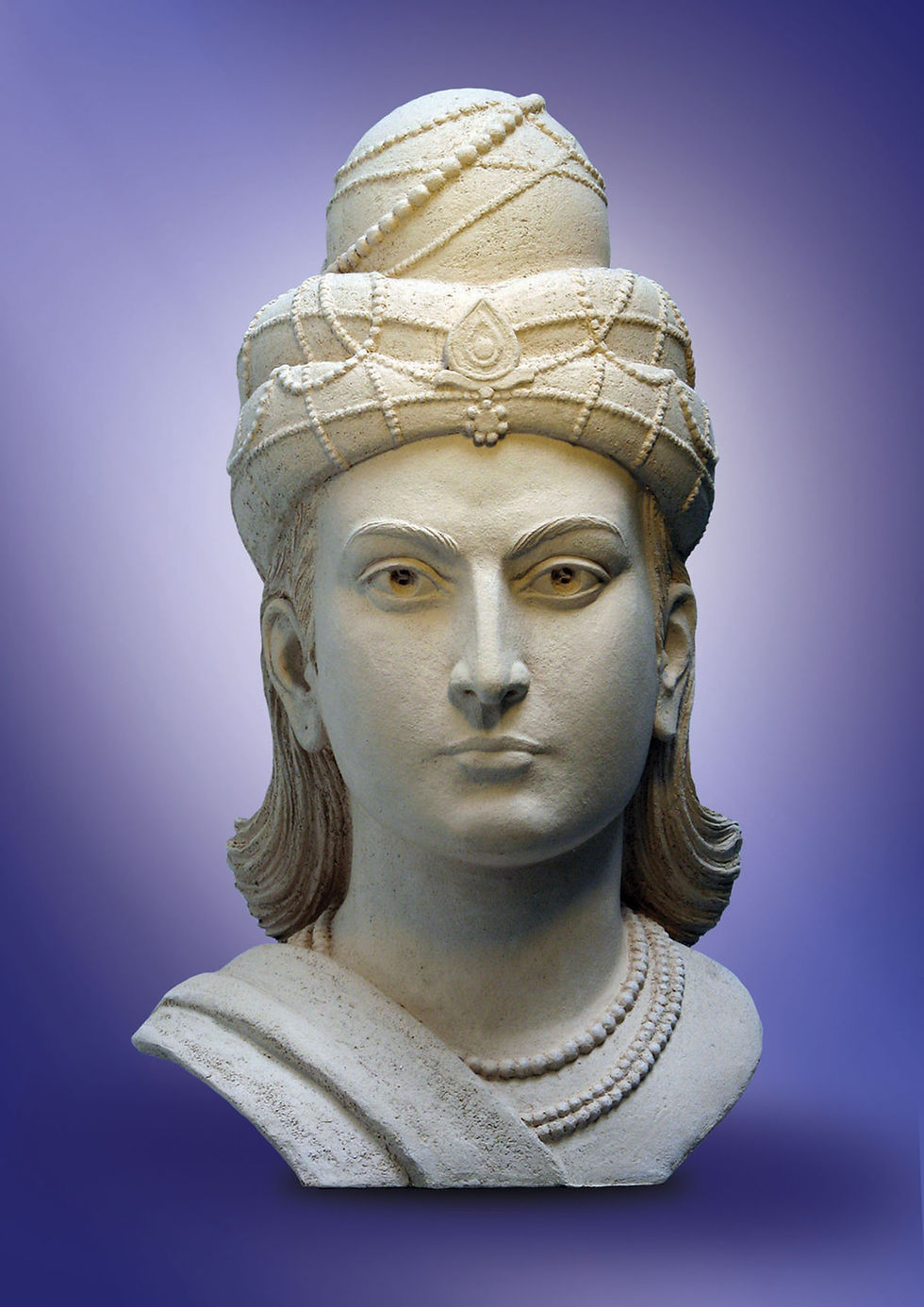
Contrary to the popular belief he adopted Buddhism way before the Kalinga war. It was rather a political decision than a personal one, as most of his courtiers were Buddhists and would side him in case of any rebellions by Jain Ajeevikas. Shortly after the Kalinga he went ahead and massacred the last clan of Ajeevikas.
Now, if he had felt any regret, he would have surely bothered to apologize to the people whom he had wronged i.e the people of kalinga but in none of the inscriptions in Kalinga he talks about remorse. In fact it is on the inscriptions in Baloch where he expresses his remorse. But even in that inscription he says "told of the power to punish them that Devanampriya possesses in spite of his repentance, in order that they may be ashamed of their crimes and may not be killed". Not so remorseful!
This is why after Ashoka the Mauryan Dynasty went into decline just as the Mughal after Aurangzeb.
This is the main reason why there is no mention of Ashoka in old Indian texts. He was forgotten until the British rediscovered and Nehru immortalized him.
After dealing with Ashoka our history takes a giant leap of almost 1000 years without mentioning Satavahanas, pandyas, cholas etc..
2. Medieval Phase(998 AD- 1030 AD & 1191 AD-1700 AD)
This phase starts with the exploits of Mehmood Ghaznavi, how he raided India 17 times and how he destroyed the Somnath temple in his last raid in 1026.
After Ghaznavi we are taught about Mohammed Gori's invasions which happen around 1191. There's a gap of around a century between Gaznavi and Gori which was conveniently omitted where Ghaznavi was defeated by Gonda tribes of Central India. This feared the Turks so much that they feared to invade India for a century.
Battle of Bahraich(1034 AD):
After infamous raid on Somnath Temple a large army of Ghaznavi led by his nephew, Ghazni Sayyad Masud raided North West India. Masud advanced towards Malwa and Gujarat . King Mahipal Tomara tried to check their advance here but was defeated. After victories across North Indian plains, Masud Ghazni settled at Bahraich near Lucknow . He stayed here up to mid 1033. Meanwhile, 17 Kings of North India forged an alliance. This is the biggest confederation that have ever existed in India led by Suhaldev Sukhdev Pasi.
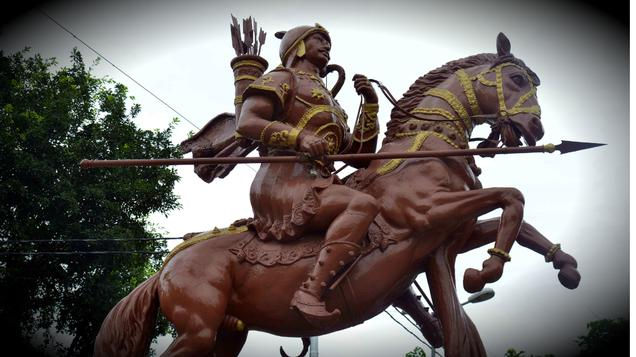
Masud Ghazni was intimated by Rajput confederation that the land belonged to Rajputs and Hindus and Masud should evacuate these lands. Masud replied that all land belongs to Khuda and hence he would not retreat. The following day tribes led by Suhaldev decimated the Turkish army and the battle came to an end with Raja Sukhdev beheading Ghazi Sayyad. This feared the Turks so much that never ventured into India for the next 100 years.
After this we have a very detailed history of the Delhi Sultanate, Various dynasties and the Mughals. The entry of the Portuguese, the Dutch and the French.
Treaty of Tordesillas of 1494 signed between Spain and Portugal which said that all the lands to the west belonged to the Spanish and the all the lands to the east belonged to the Portuguese. After the discovery of sea route to India the Portuguese colonized the south western coasts of India with Goa as their head quarters.
Abakka Chowta(1525-1570)
Maharani Abakka was the first queen of Ullal from Tuluva Dynasty. She took over Goa which was under the control of Portuguese.
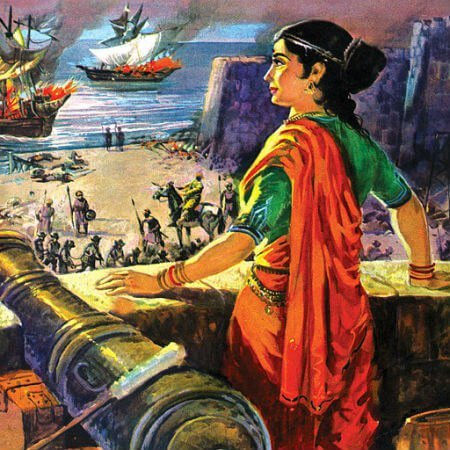
She went ahead and occupied the Ullal port which was a hub to spice trade across the Arabian peninsula. This annoyed the Portuguese but they couldn't do anything due to the strong resistance by the local chieftains of Ullal. Abakka even forged an alliance with Zamorin(Samudrin) of Calicut. She fought many battles against the Portuguese and was mainly responsible for restricting the Portuguese to the coastal regions of South West India.
Around 18th century the Mughals were having a hard time holding their territories especially during the reign of Aurangzeb. The Mughal Empire crumbled after Aurangzeb. The Marathas took over the power after Mughals. No where do we come across as to why the Mughal Empire went into decline.
Battle of Saraighat(1671 AD)
At their peak, Mughals were known for their cavalry and artillery. Aurangzeb waged a war against the Ahom's of Assam which were led by its general Lachit Borphukan.
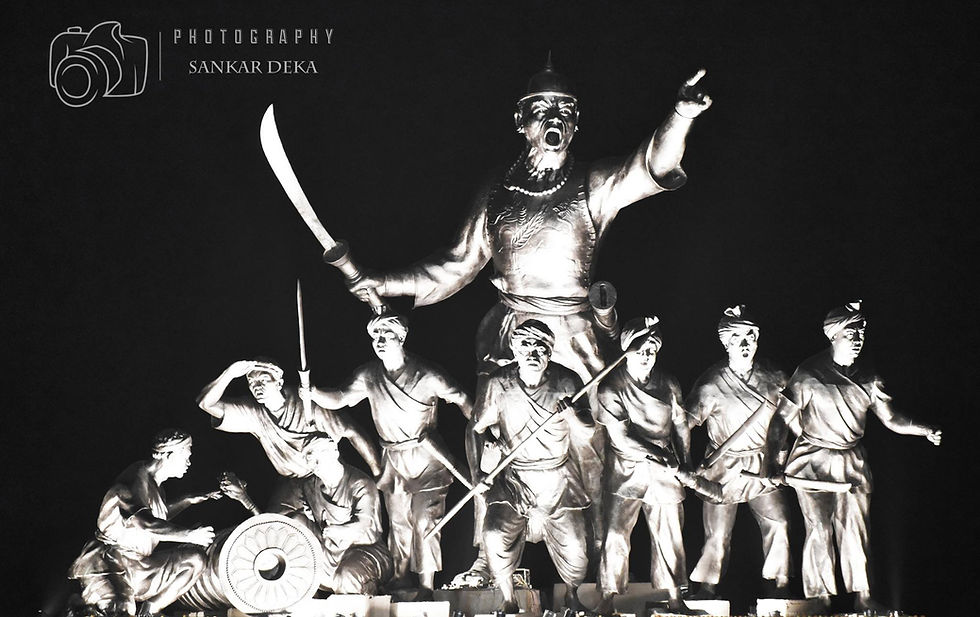
Lachit Borphukan lured the Mughal army into fighting a naval war in the Brahmaputra where the local Assamese had an advantage. In the battle Lachit Borphukan obliterated the entire Mughal fleet which was mainly responsible for the downfall of the Mughal Empire.
3. Modern phase(1700-1947)
After the death of Aurangzeb in 1707 the Marathas took over the regions ruled by him. But the maritime boarders were dominated by the Dutch East India company. Till the mid 18th century the Portuguese and the Dutch East company were the most feared trading companies for their advanced naval tactics and an insatiable appetite for violence. They controlled the entire maritime trade of South East Asia.
Battle of Colachel (1741 AD):
Odnand of Kerala was the only exporter of pepper to the rest of the world. This region was conquered by Marthanda Varma of Travancore. He realized that the Dutch power stemmed through the spice trade. So he seized the areas which were hot-spots for spice trade for the Dutch. This was a major blow to the commerce of the Dutch. Initially a treaty was signed between Marthanada Varma and the Dutch but the petty rulers who were under the control of the Dutch constantly violated the treaty. Marthanada Varma retaliated. This angered the Portuguese. Marthanda Varma decided to take on the Dutch East India company. They engaged in a Naval battle at Colachel, present day Kanyakumari in which Marthanda Varma annihilated the Dutch fleet which led the immediate downfall of the Dutch East India company.
The British rule was totally a dark phase in Indian history. Indians were exploited in every aspect. There wasn't any effort put by the Indian Moderate leaders to liberate India. There were some Pan India movements only after the Extremists took over the Congress. The 'Home Rule Movement' led by Bal Gangadhar Tilak shook the ground beneath the British. This was the movement which seeded the idea of Independence in the minds of Indian people.
Soon after this Gandhi took over the Indian national movement. Bose unimpressed by the methods of Gandhi's protests, formed the Indian National Army in 1942. Japan supported INA during the Second World War. The Defeat of Japan and the death of Subash Chandra Bose was a major blow to the INA. Some of the INA soldiers were taken captive. A trial was set up by the British against these prisoners in the Red Fort.
Royal Indian Navy Mutiny(1946):
It wasn't an overnight mutiny. The Indian navy ratings were protesting regarding the discrimination faced by them especially over the quality of food being served to the Indian sailors. The movement picked up pace when the INA prisoners were brought to trials at the Red Fort. They realized that the once mighty British empire is no longer invincible. On Feb 20 1946 the Indian sailors took control of the Ships near the Bombay and Karachi ports. Soon the movement spread to Kochi, Vizag and Kolkata. Radio sets were used to communicate among themselves. The Royal Indian Air Force joined in solidarity with the striking ratings, and 1000 men from Andheri, Marine Drive camps came in. The mutiny now began to spread like wildfire, Kolkata, Vizag, Chennai, Karachi, reverberated with slogans of “Strike for Bombay”, “Release 11,000 INA prisoners” and “Jai Hind“.
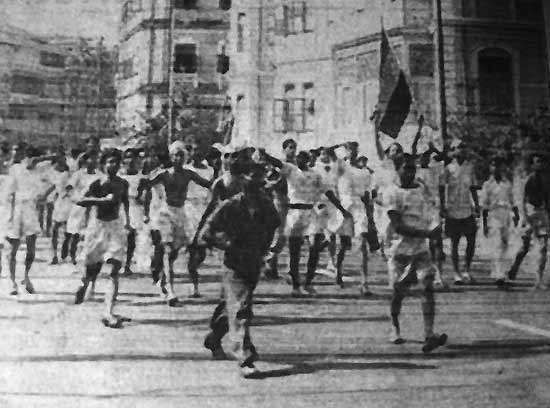
The Indian army laid down their arms to show their support to the revolt. Clement Atlee, the then Prime Minister of England was alarmed by this movement and ordered the Royal Navy to put down the revolt. J.H.Godfrey, the Flag Officer in command of the Royal Indian Navy, gave an ultimatum to the mutineers to submit or perish. The Royal Air Force flew a squadron of bombers near Mumbai harbor and Karachi harbor. The revolt at Mumbai was put down and after three days the Karachi ratings surrendered due to lack of support from the Congress. The mutiny finally came to an end after 4 days. Negotiations took place and most of the demands were conceded. All the INA prisoners were released. 7 RIN sailors and 1 officer was killed, while around 34 were injured and 476 discharged from duty.
The INC and the AIML openly condemned the mutiny. The only party that supported it was the Communist Party. Even though the mutiny failed and was swiftly put to an end, it made the British realize the growing discontent among the Indian armed forces and it is impossible to contain such events in the future. So India was declared independent the following year.
In March, 1976 P.V.Chakraborty, former Chief Justice of Kolkata HC wrote a letter, where he described a correspondence between him and the British Prime Minister Clement Atlee in 1956 where Chakraborty asked "The Quit India Movement of Gandhi practically died out long before 1947 and there was nothing in the Indian situation at that time, which made it necessary for the British to leave India in a hurry. Why then did they do so?"
to which Atlee replied "It was Bose's INA and the Royal Indian Navy Mutiny."
Now the sad part is after India gained independence none of those dismissed were reinstated into either the Indian or Pakistani navies.
There were many unsung heroes in Indian history whose efforts were blatantly downplayed by the Nehruvian government so as to glorify their efforts.
Many historians were admirers of Nehru and hence the prejudice. Added to this, Nehru himself was a writer and wrote a few books on History too.
Our history was written in such a way that we get an impression that India was a weak country which was united and strengthened by Gandhi and Nehru.
Note: "Land of Seven Rivers" by Sanjeev Sanyal had a great influence over me. In fact most of the events mentioned in this article are discussed at length in his books and columns. I just made a mere effort in consolidating them"
Comments